
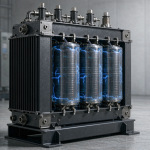
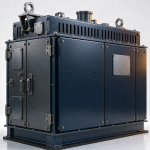
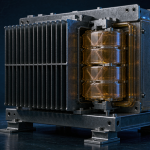
Built for U.S. Commercial, Healthcare, Data Center & Transit Projects
Why U.S. Buyers Specify This Unit
- UL 1561 Listed (dry-type general purpose & power transformer) — accepted by AHJ/NEC 450 without field re-certification
- DOE 10 CFR 431 Compliant — meets current 2016 tier, engineered to 2029 tighter tier so your 2027–2030 project won’t be stranded
- IEEE C57.12.01 / NEMA ST-20 design basis, 60 Hz typed, 220 °C insulation system (150 °C rise Class F)
- ANSI primary voltages: 15 kV / 13.8 kV / 12.47 kV class; secondary 480Y/277 V or 208Y/120 V standard
- K-13 / K-20 ready neutral 200% rated — handles VFD, UPS, server rack harmonics
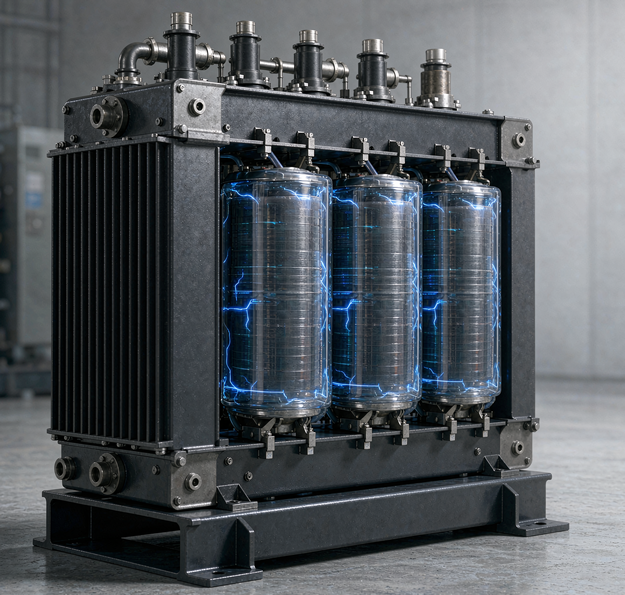
- Epoxy cast resin, F1/F0 flame class, oil-free — NFPA 850 / high-rise / hospital corridor approved
Standard Configuration (SCB13)
| Parameter | U.S. Project Typical |
|---|---|
| Rated capacity | 30 – 10,000 kVA (3-phase) |
| Primary voltage | 15 kV / 13.8 kV / 12.47 kV (±2×2.5% taps) |
| Secondary voltage | 480Y/277 V, 208Y/120 V, or 600Y/346 V |
| Frequency | 60 Hz (50 Hz available for export) |
| Vector group | Dyn11 / Yyn0 |
| Insulation / rise | Class F 155 °C system, 150 K rise (80 K / 115 K optional) |
| Enclosure | IP20 indoor (IP31/IP54 optional), NEMA 1 / NEMA 12 |
| Cooling | AN natural air, AF fans + RTD/Modbus controller optional |
| Sound level | ≤50 dB(A) @1 m (SCB13, 1 m) |
| K-factor | K-1 standard, K-13 / K-20 on request |
| Losses | No-load ~25–30% below GB/IEC Group I; meets DOE 431 table by kVA |
Compliance & Submittal Package (what your engineer will ask for)
- UL 1561 Listed file number (scope covers exact kVA + voltage)
- Routine tests: turns ratio, winding resistance, no-load/load loss, dielectric, partial discharge ≤10 pC
- Type test report: temperature rise, short-circuit withstand, sound level (IEEE C57.12.90)
- Nameplate per NEMA ST-20 + NEC 450 labeling
- 60 Hz iron loss calculation (not de-rated 50 Hz design)
- Drawings in English, inch/lb units, CSI Div 26 22 00 format
- Optional: OSHPD pre-approval (CA hospitals), IEEE 693 seismic, cULus for Canada
Where It Goes (application mapping U.S. buyers recognize)
- Data centers — 2,500 kVA+ units, K-20, 480→208 V, N+1 / 2N, AI hall ready
- Hospitals / ASCs — F1 fire rating, low sound, 150% overload 30 min for generator test
- High-rise & mixed-use — indoor vault, no oil containment, IP54 lobby-adjacent
- Transit (metro / airport) — vibration package, salt-mist option, 27.5 kV traction feed step-down
- Schools / municipal — Title 24 / ASHRAE 90.1 efficiency path, maintenance-free
Related question answers
Q1. Is this UL 1561 Listed, or just “designed to UL”?
UL 1561 Listed, file number scoped to your exact kVA and voltage. “Designed to” gets rejected by the AHJ; a Listed number means one-step inspection. cULus available.
Q2. Does it meet the DOE 2029 efficiency rule?
SCB13 is engineered below the 2029 limit, with ~8–12% loss headroom. Bid a 2027–2030 project and never retro-fit. SCB10 cannot make this claim.
Q3. What’s the actual lead time?
4–8 weeks ex-works, UL scope included, 60 Hz core steel stocked year-round. Peak runs 10 weeks. No surcharge on tap/voltage edits before kickoff.
Q4. Can you do 480Y/277 V with a 200% neutral?
Standard — 200% neutral, K-13 default, K-20 on request. ±2×2.5% off-circuit taps, or OLTC for wide utility swings.
Q5. Sound level — units under an occupied floor?
≤50 dB(A) @ 1 m for 1,000–2,500 kVA. Add anti-vibration mounts + shielding to hold ≤45 dB(A). Third-party test per IEEE C57.12.90 included.
Q6. Seismic — California hospital, OSHPD / IEEE 693?
IEEE 693 high-level, Sds ≥ 2.0 g, anchorage included. OSHPD dossier to 500 kVA; above that we coordinate with your structural engineer of record.
Q7. What partial discharge can you guarantee?
Cast-resin HV winding, PD ≤ 10 pC at 1.5× rated, typical 3–5 pC. Vacuum-pressure-gel process, certificate ships with the unit.
Q8. Short-circuit withstand — 25 kA for 2 seconds?
Rated to IEEE C57.12.01, 25 kA/2 s standard; 31.5 kA/2 s on request. Type-tested, report available to your engineer.
Q9. Can it connect to our BMS?
Yes — 3× PT100 + RTD + ambient sensor, Modbus RTU/TCP standard, BACnet optional, NEMA 4X controller, dry-contact alarm/trip relays.
Q10. What’s the landed cost and 25-year TCO?
EXW in USD, or DDP to your U.S. warehouse — tell us the point and we price both. At $0.11/kWh, the loss delta pays back in ~3.5–4 yrs; ~$12–18k saved over 25 yrs, and you avoid a $40k+ replacement when DOE 2029 hits.