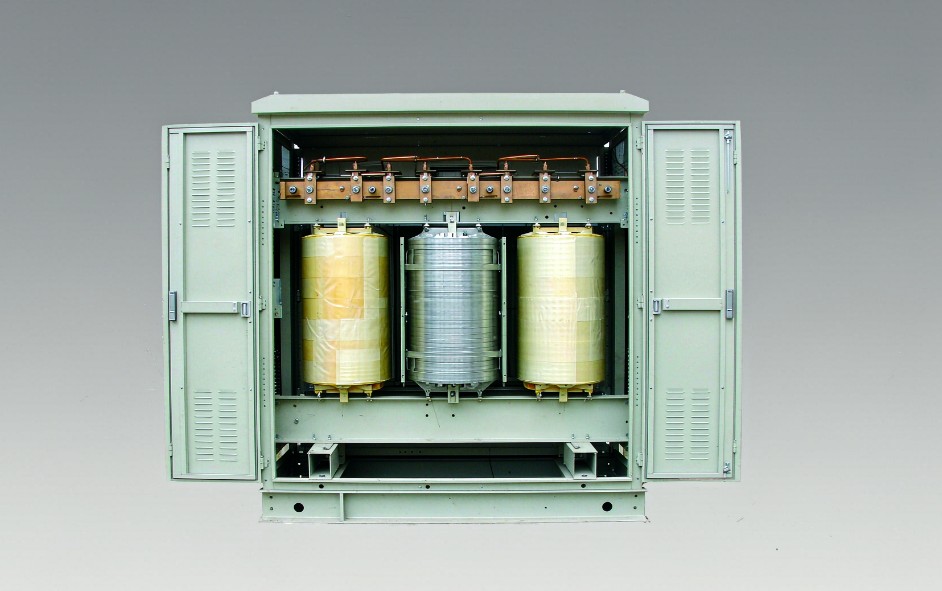
- Capacity: 10 kVA – 1 MVA
- Voltage: up to 35 kV
- Core: amorphous alloy ribbon
- Cooling: AN / AF
The SCBH15 Amorphous Alloy Dry-Type Transformer is a high-efficiency distribution transformer engineered for the North American market, combining the ultra-low-loss advantages of amorphous metal core technology with the safety and reliability of cast-resin dry-type construction. It delivers up to 70% reduction in no-load losses compared to conventional silicon-steel transformers, making it an ideal solution for utilities, commercial facilities, and green-building projects with continuous-duty, part-load load profiles-1-14.
The transformer is particularly suited for applications where fire safety, environmental responsibility, and long-term energy savings are critical decision factors. Typical installations include data centers, hospitals, schools, commercial office buildings, renewable energy projects, and underground distribution systems-1-20.
Key Features and Benefits
| Feature | Benefit |
|---|---|
| Amorphous alloy ribbon-wound core | No-load loss reduced by up to 70% vs. conventional silicon-steel; lower hysteresis and eddy current losses due to non-crystalline atomic structure-16 |
| Epoxy resin cast-coil construction | High insulation strength, excellent short-circuit withstand capability, flame-retardant and self-extinguishing-1-14 |
| Three-phase five-limb core design | Optimized magnetic circuit for reduced losses and quiet operation-7 |
| Low partial discharge | Enhanced dielectric performance and extended service life-7-20 |
| Maintenance-free operation | No oil, no moving parts, minimal routine maintenance required-20 |
| Moisture and corrosion resistance | Suitable for harsh environments including underground vaults and humid locations-1 |
| High overload capability | Supports continuous safe operation at elevated load levels-20 |
| Compact footprint | Space-efficient design suitable for retrofit and new construction projects |
Technical Specifications (Representative Model: SCBH15-2500/10)
| Parameter | Value |
|---|---|
| Rated Capacity | 2500 kVA |
| Rated Voltage Ratio | 10 kV / 0.4 kV |
| Rated Frequency | 50/60 Hz |
| Short-Circuit Impedance | 6% |
| Connection Symbol | Dyn11 |
| Insulation Level | LI75AC35 / AC3 |
| Cooling Method | AN/AF (Air Natural / Air Forced) |
| No-Load Loss | ≤ 1.2 kW |
| Load Loss | ≤ 18.4 kW |
| Temperature Rise Limit | ≤ 125 K |
| Noise Level (Sound Power) | ≤ 60 dB(A) |
| Insulation Class | Class F or above |
| Core Material | Amorphous alloy ribbon |
| Winding Material | Copper foil (LV) / Epoxy-encapsulated copper (HV) |
Note: Specifications vary by capacity rating and configuration. Available capacity range: 30 kVA to 2500 kVA-7. Custom voltage ratios and impedance values available upon request.
Common Questions & Answers
Q1: What makes the SCBH15 transformer different from a standard silicon-steel dry-type transformer?
A: The primary difference is the core material. The SCBH15 uses an amorphous alloy ribbon-wound core instead of conventional grain-oriented silicon steel (CRGO). Amorphous metal lacks a crystalline atomic structure, which dramatically reduces hysteresis losses (the energy lost each time the magnetic field reverses). Combined with its thin ribbon gauge and high electrical resistivity (approximately 130 μΩ·cm⁻¹ vs. 50 μΩ·cm⁻¹ for CRGO), eddy current losses are also significantly lower-16. The net result: up to 70% lower no-load losses compared to equivalent silicon-steel designs-14.
Q2: How much energy can I actually save over the transformer’s lifetime?
A: Savings depend on load profile and electricity rates, but the economics are compelling. Because no-load losses occur 24/7 regardless of load, even lightly loaded transformers consume significant energy over their 20-to-40-year service life-11. For a typical distribution transformer, a well-designed amorphous core unit can return its initial cost premium in 2 to 5 years through reduced energy losses alone-4. Over a 40-year life expectancy, the total cost of ownership advantage is substantial-11.
Q3: Is the SCBH15 safe for indoor installation in occupied buildings?
A: Yes. Dry-type transformers contain no oil and no flammable liquids, making them inherently safer than liquid-filled alternatives for indoor use-18. The SCBH15’s epoxy cast-coil construction is flame-retardant and self-extinguishing, and will not contribute to fire propagation or release toxic gases-1-20. This makes it suitable for installation inside commercial buildings, hospitals, data centers, and underground vaults where fire safety requirements are stringent-5.
Q4: What are the ideal applications for this transformer?
A: The SCBH15 is optimal for:
-
Green building projects seeking LEED or ENERGY STAR recognition
-
Utility distribution systems with continuous-duty, part-load profiles
-
Data centers and telecom facilities requiring high reliability and low losses
-
Renewable energy installations (solar, wind) where efficiency directly impacts project economics
-
Commercial and institutional buildings where indoor installation is required
-
Underground substations and compact urban distribution networks-20
Q5: How does the SCBH15 compare on noise levels?
A: Amorphous metal cores exhibit slightly higher magnetostriction than silicon-steel cores, which can translate to 3–5 dB higher sound levels in unmitigated designs-16. However, the SCBH15 addresses this through optimized core clamping and enclosure design, achieving ≤ 60 dB(A) sound power level for the 2500 kVA rating-1. This meets typical indoor installation requirements for commercial buildings. For noise-sensitive applications, specify low-noise construction options.
Q6: What certifications and standards apply to the SCBH15 for the U.S. market?
A: For U.S. deployment, the SCBH15 should be evaluated against the following standards:
-
UL 1561 – Dry-Type General Purpose and Power Transformers (K-9 rated where applicable)-2-9
-
DOE 2016 Efficiency Standards (10 CFR Part 431) – Required for distribution transformers in the U.S.-9
-
NEC Article 450 – Transformer installation requirements-18
-
IEEE C57.12 series – General requirements for dry-type transformers
-
CSA C22.2 No. 47 – Canadian dry-type transformer standard (for Canadian projects)-2
Specifiers should require UL listing and DOE 2016 compliance on all submittals. ENERGY STAR qualification may apply depending on the specific model and capacity-19.
Q7: What about the higher first cost — is it justified?
A: The first-cost premium is typically 10–15% over an equivalent silicon-steel transformer-4. However, this must be evaluated using Total Owning Cost (TOC) methodology rather than first cost alone. The TOC calculation capitalizes the present value of all future energy losses (no-load + load) over the transformer’s life. For any application with meaningful energy costs, the SCBH15’s TOC is consistently lower. The U.S. EPA and utility programs actively promote TOC-based evaluation for exactly this reason-19.
Q8: What are the maintenance requirements?
A: The SCBH15 is essentially maintenance-free. There is no insulating oil to test or replace, no gaskets to leak, and no moving parts. Recommended maintenance consists of periodic visual inspection and cleaning of ventilation pathways to ensure adequate airflow. The cast-resin windings are resistant to moisture, mold, and salt fog, further reducing maintenance needs-20. This low maintenance profile makes the transformer ideal for unattended or remote locations.
Energy Savings: How Amorphous Core Technology Works
The Science Behind the Savings
Amorphous metal is produced by rapidly cooling molten alloy at rates of approximately 1 million °C per second, which prevents the atoms from forming a regular crystalline lattice. The resulting non-crystalline (amorphous) structure has several magnetic advantages-16:
-
Low Hysteresis Loss: The absence of crystalline anisotropy means the material magnetizes and demagnetizes with less energy input.
-
Low Eddy Current Loss: The ribbon is extremely thin (typically ~0.025 mm) and has 2–3× higher electrical resistivity than silicon steel, suppressing circulating currents within the core.
-
Optimized Annealing: Post-production heat treatment in a magnetic field defines a preferred magnetization direction, further reducing losses-16.
Quantified Environmental Impact
For a 1,000 kVA amorphous core transformer, the avoided CO₂ emissions over a 20-year operating period can reach 140,000 tons compared to a conventional silicon-steel unit-16. At the national scale, widespread adoption of amorphous core transformers in the U.S. could save approximately 84 TWh annually and reduce CO₂ emissions by 60 million tons per year-16.
Target Applications in the U.S. Market
Utilities & Distribution
-
Continuous-duty, part-load profiles: Amorphous transformers are ideal for utility distribution circuits where load factors are low and no-load losses dominate total losses.
-
ENERGY STAR and efficiency programs: Utilities qualifying for energy-efficiency credits can deploy SCBH15 to meet program targets-19.
Green Buildings & LEED Projects
-
LEED Energy & Atmosphere credits: High-efficiency transformers contribute to Optimize Energy Performance credits.
-
No oil = no secondary containment: Simplifies permitting and reduces civil works costs.
-
Indoor installation: No vault required (subject to NEC clearance requirements).
Commercial & Institutional
-
Hospitals, data centers, labs: Where fire safety, reliability, and low loss are paramount.
-
Airports, subway systems, ports: Harsh environment resistance and compact footprint.
-
Renewable energy projects: Solar farms, wind installations, and battery storage systems where efficiency directly affects project ROI-20.
Installation & Sizing Guidance (U.S. Practice)
Sizing Principles
Transformer kVA rating should be selected based on calculated load + 20% spare capacity for future growth-5. For commercial buildings, the load is typically calculated in kVA from the panel schedule, and the next standard size is selected.
Environmental Derating
Standard ratings assume 40°C ambient (or 30°C daily average) and altitude ≤ 3,300 ft. For higher ambient temperatures, derate by 8% per 10°C above 40°C (air-cooled dry-type). For altitudes above 3,300 ft, derate by 0.3% per 330 ft-18.
Ventilation Requirements
Dry-type transformers require adequate ventilation to dissipate heat. For indoor installations, provide ventilation openings sized per NEC and manufacturer guidelines. Forced-air (AF) cooling can increase capacity by approximately 25–30% when required.
Grounding & Protection
-
Core must be visibly grounded to the enclosure via a flexible conductor per NEC and UL requirements-2.
-
Primary protection typically uses fuses or circuit breakers sized per NEC Article 450.
-
Secondary protection for the 480V/208V common voltage configuration uses a main breaker in the downstream panelboard.
Compliance & Certification Checklist
| Requirement | Standard / Specification | Status |
|---|---|---|
| UL Listing | UL 1561, Dry-Type General Purpose Transformers | ✅ Required for U.S. |
| DOE Efficiency | 10 CFR Part 431 (DOE 2016) | ✅ Required |
| ENERGY STAR | EPA Transformer Program | Optional/Model-dependent |
| CSA (Canada) | CSA C22.2 No. 47 | Required for Canada |
| NEC Installation | NFPA 70 Articles 450, 210.20 | Required |
| Insulation System | 220°C UL-recognized component | Specified by UL 1561 |
| K-Rating (Harmonics) | K-9 or higher for nonlinear loads | Specify if applicable |
Specifiers should require certification documentation with every submittal, including UL file number, DOE compliance statement, and test reports for losses and temperature rise-2.
Summary
The SCBH15 Amorphous Alloy Dry-Type Transformer represents the convergence of advanced materials science and proven cast-resin transformer engineering. For U.S. utilities, green-building specifiers, and commercial facility managers, it offers a compelling total-cost-of-ownership case: lower energy losses from day one, reduced CO₂ footprint, enhanced fire safety, and virtually maintenance-free operation. When evaluated on a total owning cost basis — as U.S. energy policy increasingly requires — the SCBH15 is not merely a premium option but a cost-effective standard for modern distribution infrastructure.